SECTOR SPOTLIGHT

Different industries, different pressures.

Across the many sectors of South Africa’s economy, deskless workforce lives with little margin for error.

Our data shows that the pressures look slightly different depending on the industry: some workers find stability in tenure and clear promotion ladders, while others face daily struggles that leave them one crisis away from collapse. 

What unites them is that fragility takes a different shape in every sector and a one-size-fits-all response from employers won’t work.

For leaders, these differences represent both a risk and an opportunity: predictable fragility can be prevented and targeted action can deliver measurable business returns.

Across the many sectors of South Africa’s economy, deskless workforce lives with little margin for error.

Our data shows that the pressures look slightly different depending on the industry: some workers find stability in tenure and clear promotion ladders, while others face daily struggles that leave them one crisis away from collapse. 

What unites them is that fragility takes a different shape in every sector and a one-size-fits-all response from employers won’t work.

For leaders, these differences represent both a risk and an opportunity: predictable fragility can be prevented and targeted action can deliver measurable business returns.

SECTOR SPOTLIGHT

Different industries, different pressures.

Across the many sectors of South Africa’s economy, deskless workforce lives with little margin for error.

Our data shows that the pressures look slightly different depending on the industry: some workers find stability in tenure and clear promotion ladders, while others face daily struggles that leave them one crisis away from collapse. 

What unites them is that fragility takes a different shape in every sector and a one-size-fits-all response from employers won’t work.

For leaders, these differences represent both a risk and an opportunity: predictable fragility can be prevented and targeted action can deliver measurable business returns.

CLEANING

Pride under pressure

Cleaners report some of the highest levels of job enjoyment (97%) but sit on the most fragile ground.

  • 61% have no savings, and 77% experience financial stress, with transport (43.8%) and low wages (28.8%) topping the list of challenges.

  • Promotion clarity is low (35%), and while interest in savings products is strong (4.23/5), only 35% use EWA. Long commutes and low pay drain income before anything can be set aside.

They work with pride and connection, but that pride doesn’t pay the taxi fare. The mismatch between motivation and means makes cleaners the most exposed group. They’re often one disruption away from a financial crisis.

What the industry leaders are doing

Top employers in cleaning provide transport stipends or shuttles for early and late shifts, while recognition schemes reward reliability.

CHRO TAKEAWAY

Pride alone doesn’t cover transport costs; tangible financial support should come first, with recognition layered in to sustain morale and engagement.

CHRO TAKEAWAY

Pride alone doesn’t cover transport costs; tangible financial support should come first, with recognition layered in to sustain morale and engagement.

CFO TAKEAWAY

Transport support reduces absenteeism, stabilising coverage and reducing emergency overtime costs.

CFO TAKEAWAY

Transport support reduces absenteeism, stabilising coverage and reducing emergency overtime costs.

I try by all means to do my work 100%, but come month end my salary is not enough knowing that I've put so much effort. At the end of the day stress is killing me.

– Cleaning services, male (45-54)

I try by all means to do my work 100%, but come month end my salary is not enough knowing that I've put so much effort. At the end of the day stress is killing me.

– Cleaning services, male (45-54)

I try by all means to do my work 100%, but come month end my salary is not enough knowing that I've put so much effort. At the end of the day stress is killing me.

– Cleaning services, male (45-54)

RETAIL

Squeezed from both sides

Retail staff face pressure both at work and at home.

Unclear communication (26.3%) and low wages (25.2%) are key stressors, alongside transport (23.6%).

Financial stress is highest here (79%), with 58% reporting no savings. Job enjoyment is lower than other sectors (90%), and promotion clarity sits at 38%.

Retail workers are also the heaviest users of EWA (76%), underlining how often day-to-day survival depends on bridging cash flow gaps. They are eager for savings tools (4.37/5 interest) but survival leaves little space for stability. Recognition and communication gaps amplify the strain, risking disengagement and churn.

CHRO TAKEAWAY

Build recognition into daily workflows and communicate clearly about schedules and expectations.

CHRO TAKEAWAY

Build recognition into daily workflows and communicate clearly about schedules and expectations.

CFO TAKEAWAY

Introduce micro-savings and reduce schedule volatility to cut turnover and training costs.

CFO TAKEAWAY

Introduce micro-savings and reduce schedule volatility to cut turnover and training costs.

What the industry leaders are doing

Progressive retailers use digital recognition platforms and experiment with payroll-linked micro-savings features to reduce churn.

Communicate all necessary information regardless of its importance, because every bit of information is important. Encourage staff for all their efforts and make the workplace a friendly and happy place. Happy staff = happy customers.

– Retail worker, female (25-34)

Communicate all necessary information regardless of its importance, because every bit of information is important. Encourage staff for all their efforts and make the workplace a friendly and happy place. Happy staff = happy customers.

– Retail worker, female (25-34)

Communicate all necessary information regardless of its importance, because every bit of information is important. Encourage staff for all their efforts and make the workplace a friendly and happy place. Happy staff = happy customers.

– Retail worker, female (25-34)

SECURITY

Relatively stable, but still stretched

Security guards show what relative stability looks like. They report high enjoyment (97%), clearer promotion pathways (49%), and stronger team connection.

Though 43% have no savings, it is significantly lower than retail or cleaning, and financial stress is also lower (62%).

Their biggest stressors are transport (34.2%) and safety (13.7%). EWA usage is 51%, and interest in savings remains strong (4.12/5). Security work illustrates how clearer career ladders and recognition can offset fragility, but transport costs and safety risks still erode buffers.

CHRO TAKEAWAY

Invest in certificates and recognition to reinforce engagement and career confidence.

CHRO TAKEAWAY

Invest in certificates and recognition to reinforce engagement and career confidence.

CFO TAKEAWAY

Subsidised transport reduces disruption, while training reduces liability and turnover.

CFO TAKEAWAY

Subsidised transport reduces disruption, while training reduces liability and turnover.

What the industry leaders are doing

Leading security firms invest in training certifications, recognition schemes, and subsidised transport to strengthen site reliability and morale.

I spend more money on transport since I knock off very late. Transport at night is very expensive and there is no allowance for it.

– Security worker, female (25-34)

I spend more money on transport since I knock off very late. Transport at night is very expensive and there is no allowance for it.

– Security worker, female (25-34)

I spend more money on transport since I knock off very late. Transport at night is very expensive and there is no allowance for it.

– Security worker, female (25-34)

Why a sector-specific view matters

A cleaner, a cashier, and an officer may stand shoulder to shoulder at one shop, but their financial realities are not the same. Cleaners are most exposed, retail workers are most reliant on short-term fixes, and security guards, while steadier, still carry stress. Fragility has a sectoral fingerprint, and it shows up differently in absenteeism, churn and disengagement. 

Employers who act sector by sector can prevent predictable fragility and convert vulnerability into advantage: reliable attendance, stronger retention, and safer, more productive operations. Tailored action is not just compassion. It is strategy. Leaders who invest now will build loyalty and resilience. Those who don’t will keep paying hidden costs in missed shifts, accidents, and turnover.
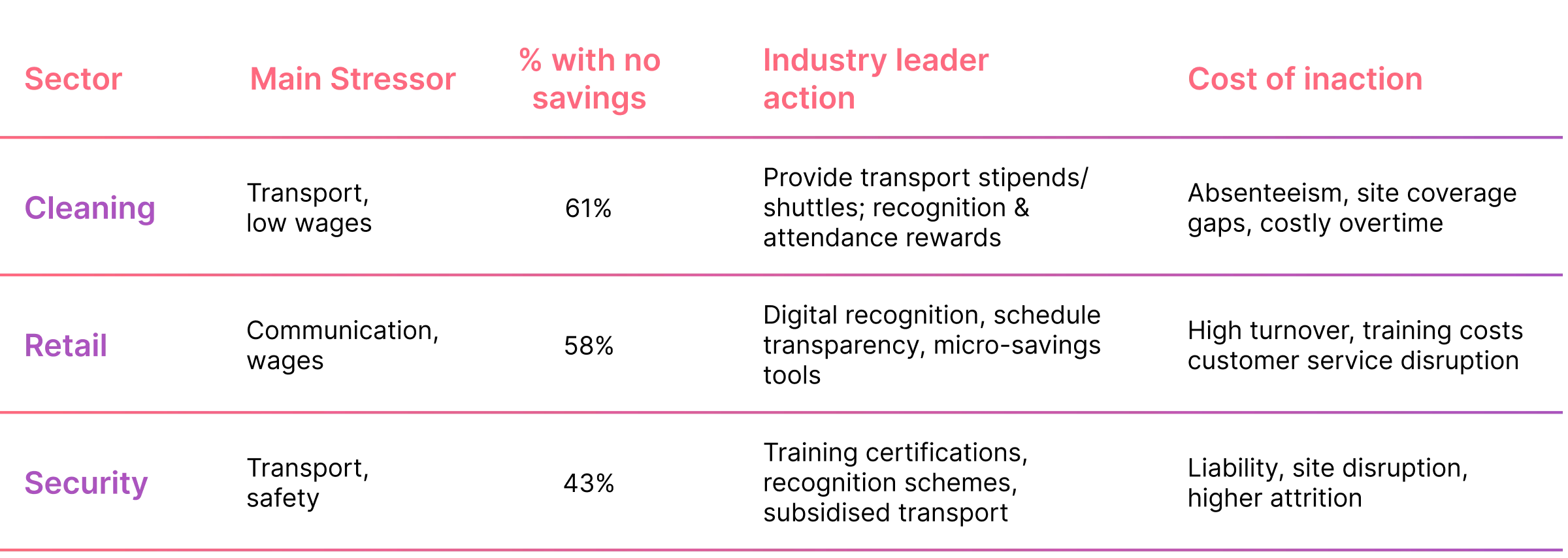
Sector comparison at a glance

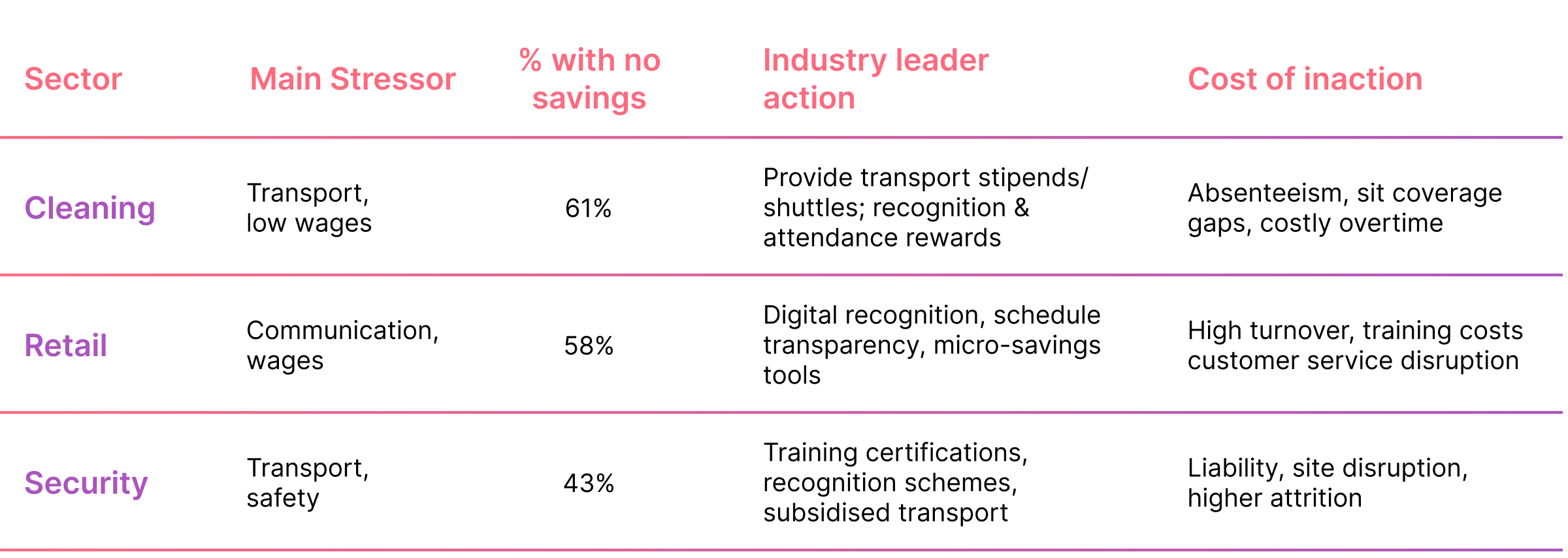
Sector comparison at a glance

©2025 Jem HR Ltd – All Rights Reserved

©2025 Jem HR Ltd – All Rights Reserved

©2025 Jem HR Ltd – All Rights Reserved

Start Here

Insights